Home | Articles | Analog Film
Kodak TRI-X vs T-MAX: Which B&W Film Preset Is Right for You?
Richard ♦ June 19, 2026 ♦ 12 min read
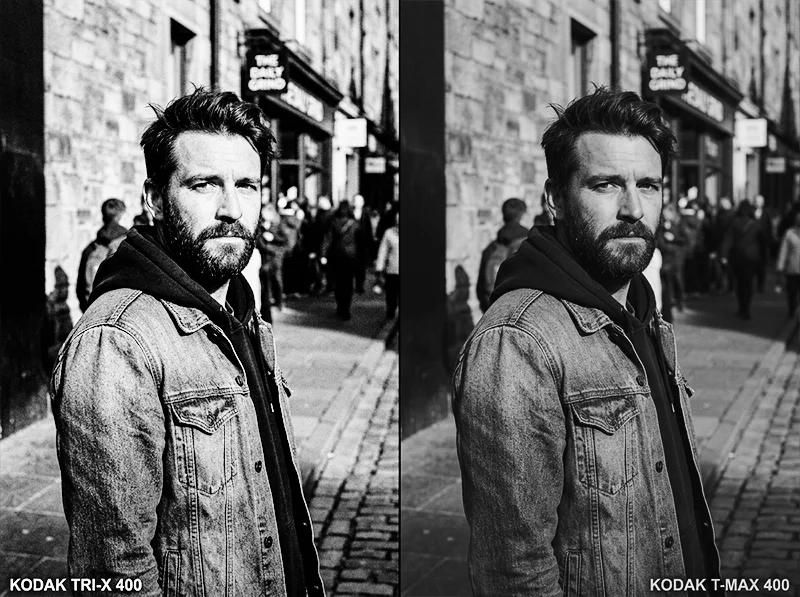
Pick up any book on black and white photography and you’ll find TRI-X in half the captions. Browse the technical forums and T-MAX comes up every time someone asks about fine grain. Both are Kodak. Both are ISO 400 options. Both produce images that look nothing alike.
Choosing between them isn’t about which film is better. It’s about what your subject needs and what you want the image to feel like. The wrong choice isn’t a disaster, but the right one makes the edit significantly easier.
This guide breaks down how TRI-X and the T-MAX family actually differ, where each one works best, and how to decide which black and white Lightroom preset fits your work.
Key Takeaways
- TRI-X and T-MAX 400 are both ISO 400 films but produce very different results. TRI-X has coarser grain and higher native contrast. T-MAX 400 is cleaner, smoother, and more controlled.
- T-MAX comes in three speeds: 100, 400, and 3200. Each serves a different purpose. TRI-X sits closest to T-MAX 400 in speed but not in character.
- TRI-X suits street, documentary, and reportage work where grain and energy are part of the image
- T-MAX 100 suits landscapes, architecture, and studio work where tonal gradation and sharpness matter most
- T-MAX 3200 is a specialist stock for low light, not a general-purpose film
- If you’re undecided, shoot the same subject with both presets and compare at viewing size, not 100% crop
01.
The Core Difference
TRI-X was designed in an era when grain was considered part of a film’s character. Kodak’s T-MAX line came later, in 1986, using a tabular grain emulsion technology that was specifically developed to produce finer, more uniform grain at higher film speeds. The two films were built with different goals.
That difference shows up in three ways in Lightroom when you apply the presets.
Grain structure. TRI-X grain is chunky, irregular, and clusters in shadow areas. T-MAX grain is fine, uniform, and distributed evenly across the tonal range. At the same ISO and the same print size, TRI-X looks grittier. T-MAX looks cleaner.
Native contrast. TRI-X has a steeper characteristic curve. Shadows go darker faster, highlights hold longer. T-MAX has a more gradual curve with smoother tonal transitions between zones. TRI-X feels punchy. T-MAX feels measured.
Tonal range. T-MAX 100 in particular has a wider usable tonal range than TRI-X at ISO 400. It holds more gradation in both highlights and shadows simultaneously, which is why landscape and architecture photographers prefer it. TRI-X sacrifices some of that range for the contrast punch.
02.
TRI-X 400: What It Does Well
TRI-X is the default film for a reason. It’s forgiving, it’s fast enough for most outdoor and indoor situations, and its visual character suits a wide range of street and documentary subjects.

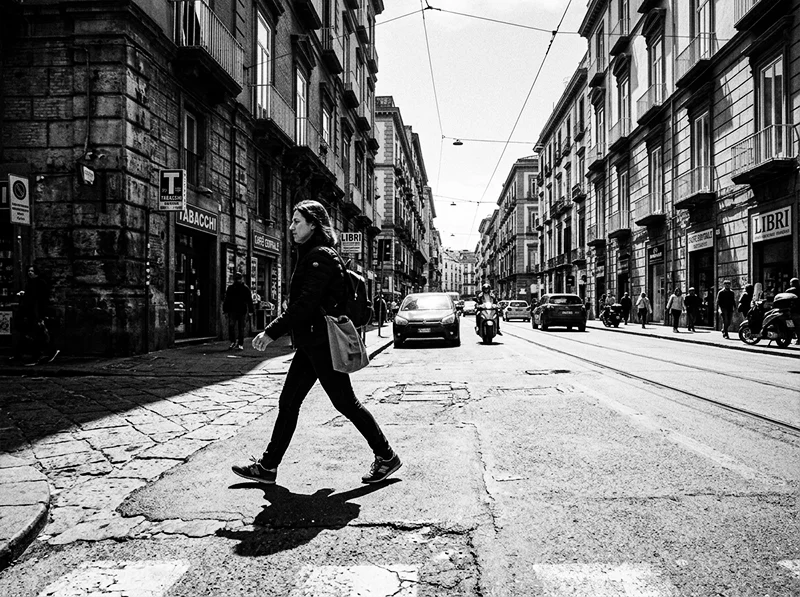
TRI-X’s high native contrast and coarse grain suit street scenes where energy and texture are part of the image. The grain isn’t a flaw. It’s structural. It adds texture to flat surfaces, depth to shadow areas, and an organic quality that makes digital captures feel less clinical. When you apply the TRI-X preset to a street scene with strong directional light, the contrast and grain work together to give the image a decisive, physical feel.
Where TRI-X preset works best:
- Street and documentary photography in natural or mixed light
- Reportage and event shooting where energy matters more than technical precision
- Any subject where grain adds to the atmosphere rather than distracting from it
- Pushing the look toward high contrast with deep blacks and open highlights
Where TRI-X preset struggles:
- Fine art portraits where smooth skin tones are the priority
- Landscapes where subtle tonal gradation across sky or water needs to be visible
- Architecture with fine detail that the heavy grain obscures
- Any situation where a clean, contemporary B&W look is the goal
03.
T-MAX 100: What It Does Well
T-MAX 100 is a different tool entirely. ISO 100 means it needs good light, which limits it to controlled situations. In return, it gives you the finest grain and the widest tonal range in the Kodak B&W catalogue.
T-MAX 400 on a portrait in soft light: smooth tonal transitions across skin, fine grain, and a controlled contrast that doesn’t fight the subject. If you’ve ever looked at a large-format landscape print and noticed how every tonal gradation from the darkest shadow to the brightest cloud is visible and distinct, that’s the kind of result T-MAX 100 produces. Not because it’s better than TRI-X in an absolute sense, but because it was built for a different job.
Where T-MAX 100 preset works best:
- Landscapes in good light where tonal gradation across sky, land, and water is the subject
- Architecture where fine structural detail matters and grain would be distracting
- Still life and product work in controlled light
- Studio portraiture where smooth tonal transitions across skin are the goal
- Any subject where maximum sharpness and minimum grain is the priority
Where T-MAX 100 preset struggles:
- Low light or indoor situations where ISO 100 would be impractical on film
- Street shooting where the clean look feels too polished for the subject
- Subjects that benefit from grain texture and high contrast
04.
T-MAX 400: The Middle Ground
T-MAX 400 is the most versatile film in this comparison. ISO 400 speed like TRI-X, but with T-MAX’s finer grain and smoother tonal character. It sits between the energy of TRI-X and the precision of T-MAX 100.
The practical difference between T-MAX 400 and TRI-X is most visible in portrait work. On a face, T-MAX 400’s finer grain and smoother contrast curve produces a result that’s clearly filmic but not aggressive. TRI-X on the same portrait can feel like the grain is competing with the subject.
Where T-MAX 400 preset works best:
- Portraits in natural or studio light where a filmic B&W look is the goal without TRI-X’s rawness
- Weddings and events where consistent, clean B&W across varied lighting is needed
- Travel photography where one versatile preset needs to cover multiple subject types
- Any situation where TRI-X feels too heavy but T-MAX 100 feels too clean
Where T-MAX 400 preset struggles:
- Subjects that specifically need TRI-X’s gritty character
- Situations where maximum tonal range is needed (T-MAX 100 is better)
- Extreme low light where T-MAX 3200’s grain character suits the atmosphere
05.
T-MAX 3200: The Specialist
T-MAX 3200 is not a general-purpose film. It’s a specialist stock for low light, and its grain character reflects that. The grain is heavy, intentional, and part of the image’s atmosphere. Using it in good light produces results that feel forced.
Where it works, it works exceptionally well. Concert photography, indoor street work, night scenes, environments where the available light is the point of the image. The grain at ISO 3200 isn’t a limitation to manage. It’s the texture of the scene.
Where T-MAX 3200 preset works best:
- Concerts and live performance where grain adds to the energy of the image
- Indoor street and documentary work in low ambient light
- Night photography where a heavy grain aesthetic fits the mood
- Any subject where dramatic shadow depth and visible grain are the intended look
TRI-X 400 T-MAX 100 T-MAX 400 T-MAX 3200 Grain Coarse, irregular Ultra-fine Fine, uniform Heavy, prominent Native contrast High Moderate Moderate High Tonal range Wide Very wide Wide Moderate Best use Street, documentary Landscape, architecture Portrait, travel, events Low light, concerts Light requirement Flexible Good light needed Flexible Low light suited 06.
How to Choose
If you’re still undecided after the breakdown above, these questions will get you to an answer faster than comparing samples online.
- What does your subject feel like?
If the answer involves words like gritty, raw, decisive, energetic, or documentary, you want TRI-X. If it involves smooth, precise, gradual, architectural, or refined, you want T-MAX 100 or 400. - What does the light look like?
Harsh, directional, high-contrast light suits TRI-X. Even, diffused, or controlled light suits T-MAX. Low light of any kind suits T-MAX 3200. - What size will the image be viewed at?
At small viewing sizes, grain differences matter less. At large print sizes, T-MAX 100’s fine grain holds up better than TRI-X’s coarser structure. - Are you shooting people or places?
Not a hard rule, but portraits and skin tones generally look better with T-MAX 400 or T-MAX 100. Street scenes and environments generally look better with TRI-X.
The full black and white preset collection includes all four stocks. The fastest way to decide is to apply both presets to the same image and compare them at the size you actually intend to use the photo.
07.
Adjusting After You Apply
Both presets are starting points. A few adjustments apply specifically to each.
Adjusting TRI-X:
- To reduce the intensity without losing character, lower the Blacks slider before touching grain
- If the contrast feels excessive on a specific image, reduce Clarity rather than Contrast. It preserves the grain texture while softening the midtone separation
- Avoid reducing Roughness in the grain panel. It removes TRI-X’s organic feel immediately
Adjusting T-MAX 100 or 400:
- If the image feels too clean and digital, add a small Amount of grain (15–20) with high Roughness to introduce organic texture
- T-MAX 100 applied to a low-light image will feel flat. Add Blacks -15 and Clarity +10 to compensate
- For portraits with T-MAX 400, try reducing the Blues channel in the B&W Mix by 5 points if the background is rendering too dark relative to the subject
Adjusting T-MAX 3200:
- This preset is calibrated for low light. Applied to a well-lit image, the grain will feel excessive. Reduce grain Amount by 15–20 points if the source image is bright
- Pull Shadows down to -20 to maintain the deep shadow character even when the overall exposure is correct
- Don’t fight the grain on this one. It’s the point.
08.
FAQ
Is TRI-X 400 better than T-MAX 400?
Neither is better. They’re different. TRI-X produces a grittier, higher-contrast result suited to street and documentary work. T-MAX 400 produces a cleaner, smoother result suited to portraits and events. The right choice depends entirely on what the subject needs.
Can I use T-MAX 100 preset on a photo shot at ISO 3200?
You can apply any preset to any image, but the results will be inconsistent. T-MAX 100 is calibrated for a specific tonal range that assumes good light and clean exposure. Applied to a high-ISO, high-noise image, the tonal transitions won’t behave the way the preset was designed. T-MAX 3200 is the right tool for high-ISO images.
Which T-MAX preset is best for portraits?
T-MAX 400 for most portrait work. It gives you the ISO flexibility for natural light shooting with finer grain than TRI-X. T-MAX 100 for controlled studio work where you can manage the light and want maximum tonal gradation on skin.
Why does TRI-X look different from T-MAX even at the same contrast setting?
Because the contrast you see in an image isn’t just from the Contrast slider. It comes from the combination of the film’s characteristic curve (encoded in the preset’s tone curve), the grain structure, and the B&W Mix channel weights. TRI-X and T-MAX have different values across all three of these. Matching the Contrast slider between presets doesn’t make them look the same.
Do the T-MAX presets include film grain?
Yes. Each T-MAX preset includes grain matched to the actual grain structure of that film stock at its native ISO. T-MAX 100 has the finest grain of the four. T-MAX 3200 has the heaviest. You can adjust grain after applying the preset, but the default values are calibrated to each stock.
Related Articles
- Black and White Lightroom Presets: The Complete Guide to Film-Based B&W
- Kodak TRI-X 400 Lightroom Preset: Street Photography’s Black & White
- Agfa Scala 200X: The World’s Only Black & White Slide Film Preset
- Lightroom Grain Settings: Amount, Size & Roughness Explained
Richard is a commercial and editorial photographer with over 15 years behind the lens. He’s shot on film and digital across three continents, and still keeps a Nikon F3 loaded with Kodak Portra on his desk. At LegendaryPresets, he leads preset development – studying actual film scans to make sure every stock behaves like the real thing.
- What does your subject feel like?